Home › Articles & Resources › Children & Families
Children & Families
Sibling conflict can become loud, emotional and hard to follow. This is a calmer way to respond: slowing the moment down, hearing each child, and guiding conflict towards repair rather than blame.
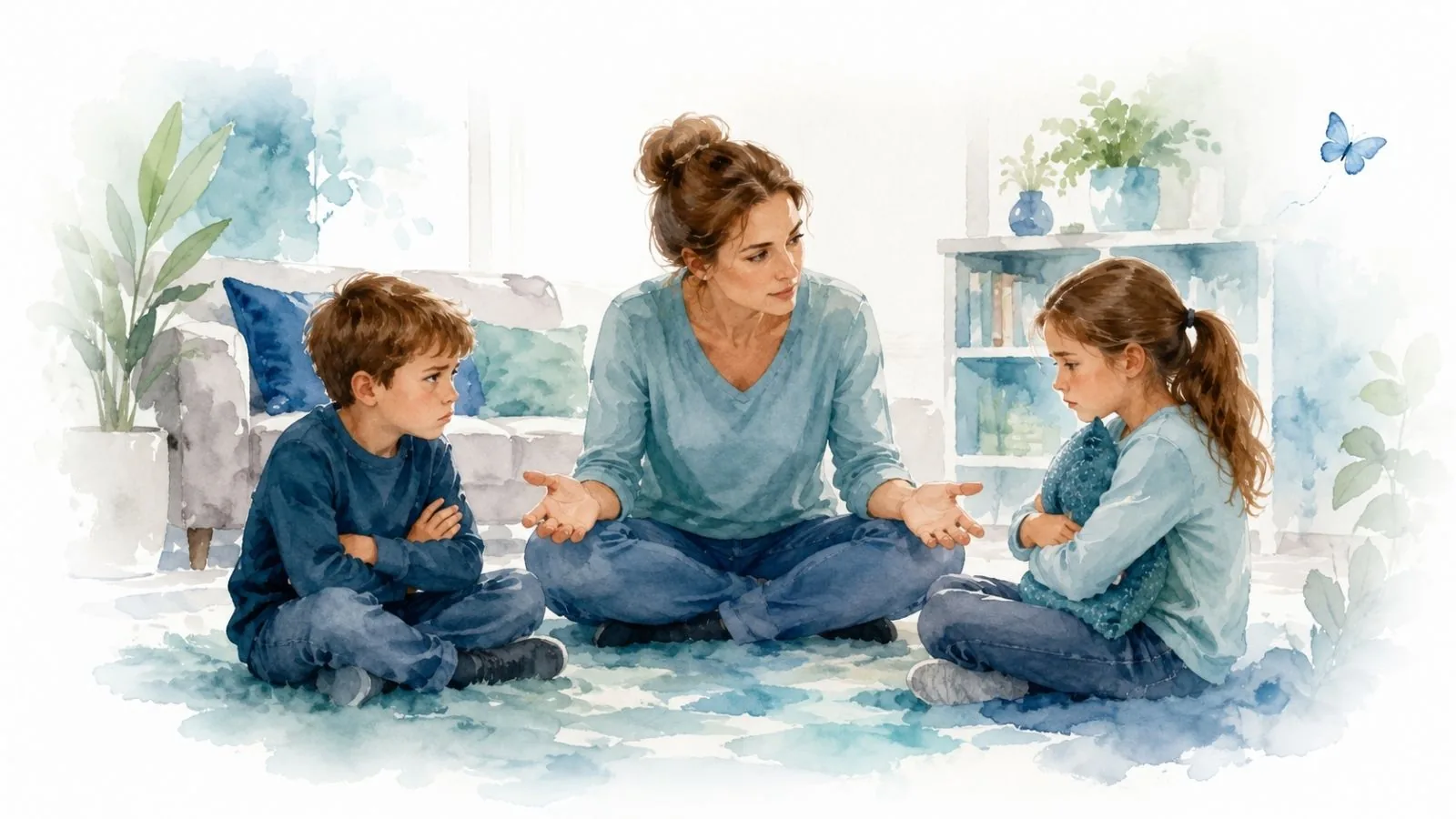
Sibling conflict is a normal part of family life, but it can quickly become overwhelming. Arguments about toys, space, fairness, screens or “who started it” often escalate fast.
One child can seem louder. One child can seem more upset. One child can appear to have caused the problem because their behaviour is the one parents notice first. But the final behaviour is not always the whole story. The shove, yell, snatch or insult often comes after a build-up.
A parent-led approach helps slow the moment down so children can understand what happened, what each person felt, what each person needed, and what needs to happen next.
Sibling conflict can look different in every family. For some children it is loud and obvious. For others it is quieter and more indirect. Parents might notice:
Children are still developing the skills needed to manage frustration, listen to another perspective and solve problems fairly. Even when children know the rules, they often need adult support to use those skills when emotions are high.
When children are upset, their nervous system can move into a protective state. In that state, they are less able to think clearly, listen carefully or consider another person’s experience. They are more likely to defend, blame, shut down, yell or act impulsively.
This does not mean the behaviour is okay. It means the child needs support to return to a state where learning and problem-solving are possible.
Sibling conflict often activates strong feelings because siblings share space, attention, family roles and daily routines. A child might be reacting to the toy being taken, but underneath that reaction there could also be a need for fairness, control, rest, attention, privacy or reassurance. When parents slow the moment down, they help children move from reaction into reflection, where they can begin to understand what happened, what they felt, what their sibling felt, what need was underneath the behaviour, and what repair needs to happen now. This is the difference between simply stopping behaviour and helping children learn from it.
Sibling conflict does not usually have one simple cause. It often develops through a mix of temperament, age, developmental stage, family stress, tiredness, unmet needs and learned patterns.
Some children are naturally more sensitive to fairness. Some need more personal space. Some struggle with impulse control. Some become overwhelmed by noise or touch. Some find it hard to lose, wait, share or shift attention. Conflict can also increase during stressful family periods, including separation, grief, school pressure, neurodivergent overwhelm, illness, moving house or changes in routine. When the family system is under pressure, children often show that pressure through behaviour. This is why sibling conflict is best understood as a family pattern, not simply a child problem.
A common misunderstanding is that parents need to work out who started it. While the sequence can matter, beginning with “Who started it?” often pushes children into blame and defence.
Another misunderstanding is that the loudest behaviour tells the whole story. The child who yelled, pushed or snatched might be the child who reached the end of their capacity after a long build-up. The behaviour still needs a boundary, but repair needs to include the wider pattern, not only the final action.
Forced apologies can also miss the point. Children can learn to say the words without understanding the impact. Repair is more useful when it helps a child take responsibility in a way that connects to what happened: giving something back, helping rebuild something, checking if someone is okay, giving space, changing the rules of a game, agreeing to ask first, or planning turns for next time.
Research on sibling relationships shows that parents play an important role in shaping how children manage sibling conflict. Parent responses that support emotional regulation, problem-solving and relationship repair can strengthen children’s ability to manage conflict over time.
Recent research also highlights that parental non-involvement in sibling conflict can contribute to ongoing sibling and parent-child conflict in some families. This does not mean parents need to step into every minor disagreement. It means children often need supported practice before they can resolve conflict well on their own. A useful goal is not constant parental control, but guided skill-building, where children slowly learn how to listen, reflect, repair and problem-solve with less adult support over time.
Before trying to mediate, parents need to check for safety. Mediation is useful when children are safe enough to talk, the parent can stay calm enough to lead, and both children can be supported to listen. If the conflict has become physical, one child feels unsafe, or the children are too overwhelmed to listen, safety comes first. In those moments, the parent’s job is to stop the harm and create space.
“I will not let bodies be hurt.”
“I am going to create space first.”
“We will come back to this when everyone is safe enough to talk.”
This approach keeps the boundary clear without turning one child into the “bad child”. Once everyone is calmer, the parent can return to the conversation and support repair.
Children borrow regulation from adults. A calm parent presence helps children move out of blame and defence and back into thinking. This does not require perfection. It only requires enough steadiness to slow the moment down.
The final behaviour still matters, especially if someone was hurt. But looking only at the final behaviour can miss the build-up. Ask what happened before things got bigger.
A child saying “sorry” while still angry, ashamed or disconnected does not always create learning. Repair works best when children understand the impact and take a fair next step.
Sibling conflict is not only about stopping arguments. It is an opportunity to teach children how to listen, understand impact, repair and try again. Safety comes before mediation. Boundaries still matter. Repair is more useful than a forced apology. The parent does not need to solve everything perfectly. A calm, steady presence helps children learn how to slow down, listen, repair and move forward.
Sibling conflict can feel exhausting, especially when the same arguments repeat. Parents do not need to manage every moment perfectly. Children learn through steady, repeated experiences of being guided back towards safety, understanding and repair. When parents slow the moment down, hold clear boundaries and help each child feel heard, conflict becomes more than something to stop; it becomes a place where children can practise the skills they need for relationships throughout life.
This framework is evidence-informed rather than a manualised treatment program. It brings together well-supported elements of parent mediation, emotion coaching and restorative repair to help parents respond to sibling conflict with safety, structure and understanding.
Jiang, M., Cao, X., Huang, Q., Wu, S., & Chen, X. (2022). Exploring the structure of sibling relationships among preschool children in China and developing a questionnaire. Frontiers in Psychology, 12, 745165.
Leijten, P. H. O., Raaijmakers, M. A. J., Orobio de Castro, B., & Matthys, W. C. H. J. (2013). Does socioeconomic status matter? A meta-analysis on parent training effectiveness for disruptive child behavior. Journal of Clinical Child & Adolescent Psychology, 42(3), 384-392.
Yue, Y., Lu, K., & Ye, D. (2024). Parental non-involvement strategy for handling sibling conflict on social avoidance in migrant children: Chain mediation of sibling conflict and parent-child conflict. PLOS ONE, 19(9), e0308561.
In South Perth and online across Australia. No referral needed.